


THE LATEST WINNING BRIEF: EB-2 NIW APPROVED FOR A CLIENT IN THE FIELD OF APPLIED PHYSICS AND MATERIALS SCIENCE
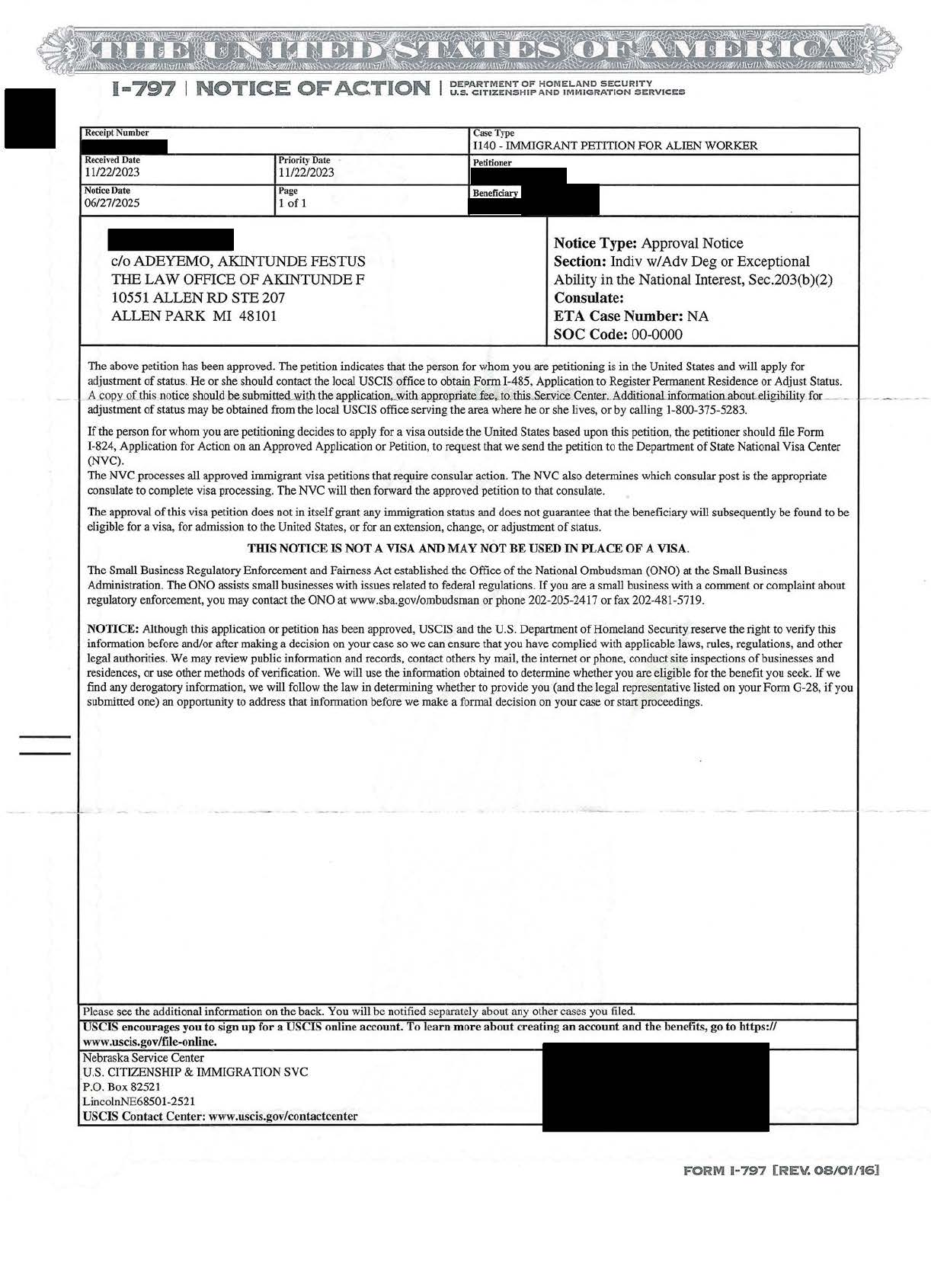
The Law Office of Akintunde F Adeyemo, PLLC has successfully represented a client in the above-cited field. The U.S. Citizenship and Immigration Services (USCIS) delivered the Approval Notice to the firm’s address yesterday. Congratulations to this brilliant client!
Having shared this life-changing news with our happy client — a doctoral researcher in Applied Physics and in Materials Science — the firm would like to provide more insights into this case. Our client’s focus on designing low-dimensional semiconductor alloys aims to enhance the performance, scalability, and reliability of next-generation microelectronic devices.
Procedural history:
On November 17, 2023, the firm filed this original EB-2 (NIW) brief.
On November 22, 2023, USCIS confirmed receipt.
On March 18, 2025, USCIS requested for additional evidence (RFE).
On May 21, 2025, the firm responded to the RFE, submitting a supplemental brief and new evidence (you cannot submit the same evidence).
On July 8, 2025, the approval notice was delivered to the firm’s address.
EB-2 (NIW) is an employment-based second preference (EB-2) - National Interest Waiver (NIW) petition, and it is one of the statutorily approved ways for qualified foreigners to become permanent residents in the U.S., and, subsequently, become U.S. citizens. For EB-2 (NIW), your location is irrelevant (the ultimate question is: can you satisfy the requirements under the Matter of Dhanasar, inter alia)? For our client who is in the U.S., as in the case at hand, his Green Card will be processed in the U.S. via the Adjustment of Status filing. Prospective clients can choose the premium processing option, which takes 45 days to adjudicate.
Here, the firm provided verifiable and credible evidence showing that our client’s proposed endeavor in the United States of America is to use his skills and work as research and development engineer to advance the U.S. semiconductor manufacturing capabilities by developing and implementing novel thin-film deposition techniques that enhance the performance, scalability, and reliability of next-generation microelectronic devices. Our client intends to design low dimensional semiconductors and multimetallic nanoalloys, which will be used in catalysis and thermoelectricity.
The brief added that our client possesses a vast knowledge base in a variety of materials processing techniques including deposition approaches. The firm submitted evidence to corroborate the fact that our client had already demonstrated an ability to work at industry-grade levels with a leading company in semiconductor technologies. Equipped with advanced deposition techniques and industry-grade materials research experience, our client is well positioned to pursue his proposed goal of advancing U.S. semiconductor manufacturing, the brief argued.
Our client — whose highest level of education at the time of filing was a Master of Science in Materials Science and Engineering — previously earned a Bachelor of Science in Materials Engineering (Summa Cum Laude). In fact, the firm provided verifiable evidence showing that our client’s research is of tremendous importance to the advancement of the U.S. competitiveness in the semiconductor global market.
In drafting the legal brief, we specifically focused on his demonstrable unique skills and accomplishments in the field of materials science, including a full-ride scholarship from the Mastercard Foundation, which was given to him for his exceptional academic and research talents. We provided evidence showing that our client, who has an in-depth knowledge of materials characterization, has published in a leading journal and uses physical vapor deposition technology in his research, among other tools, which make him a competitive talent to the United States of America.
Furthermore, the brief further argued, inter alia, that his proposed endeavor — conducting and advancing research in the field of applied physics and materials science, with a specific focus on using novel physical vapor deposition fabrication method to fabricate semiconductor-metal hybrids during the manufacturing and development of semiconductors — will lead to projected future contributions by addressing issues that the United States has deemed to be of substantial merit and national importance.
In fact, our client currently focuses on using physical vapor deposition technology to fabricate useful semiconductor-metal hybrids, which show great promise to bolster the U.S. chip development, as corroborated by distinguished professors and industry leaders with first-hand knowledge of his contributions; with his proven track record of success, our client is well positioned to advance the proposed endeavor, the brief argued.
In drafting this brief, the firm had multiple touchpoints with the client. Understanding what the client does is very critical to filing an NIW brief. Moreover, by providing verifiable evidence, the brief argued that the client — who has used physical vapor deposition to fabricate semiconductor helices and gold nanoparticles — is the kind of talent that will advance the national interest of the United States. Based on our understanding of the client’s work, the brief focused on this key area — developing a novel physical vapor deposition fabrication technology. Leveraging verifiable evidence, the brief explained that our client’s past and current accomplishments are clearly indicative of his future contributions. The brief also showed that our client has maintained a relentless commitment to boosting domestic semiconductor manufacturing.
Additionally, the carefully written 61-page brief (including the RFE brief) cited, as well as analyzed, different applicable laws, regulations, and pertinent evidence to corroborate the assertions. NIW cases are tricky, so you need to consider hiring a law firm/lawyer that understands all the nuances of the law. Before drafting every brief, we do comprehensive research on the AAO’s website, as well as review the Kurzban’s Immigration Law Sourcebook: NIW cases are won on the merit of the argument. Factual and legal arguments. In fact, it is an evidence-based petition. As in the case at hand, the firm submitted verifiable evidence showing that our client possesses an impressive record of success in his field of specialty. To support this brief, the firm submitted 105 exhibits, including evidence of advanced projects, publication and awards.
After responding to the RFE, the brief survived all the three prongs of the analytical framework in the precedent decision Matter of Dhanasar, 26 I&N Dec. 884 (AAO 2016): (1) that his proposed endeavor has both substantial merit and national importance; (2) that he is well positioned to advance the proposed endeavor; and (3) that, on balance, it would be beneficial to the United States to waive the requirements of a job offer and thus of a labor certification. And the brief established that he satisfied each eligibility requirement of the benefit sought by a preponderance of the evidence. Matter of Chawathe, 25 I& N Dec. 369, 375-76 (AAO 2010).
To satisfy the third prong of Dhanasar, relating to the question of whether it would be beneficial to the United States to waive the requirements of a job offer, and thus of a labor certification, the brief argued, inter alia, that his contributions to the field will undoubtedly benefit the United States. This is the trickiest legal analysis under the Matter of Dhanasar. There are lots of denied cases via the Administrative Appeals Office, so the firm usually considers the third prong as equally important as the first two prongs.
Here, the legal analysis focused on three of the factors enumerated by the Dhanasar Court: (1) whether, in light of the nature of our client’s qualifications or proposed endeavor, it would be impractical either for our client to secure a job offer or for his to obtain a labor certification; (2) whether, even assuming that other qualified U.S. workers are available, the United States would still benefit from our client’s contributions; and (3) whether the national interest in our client’s contributions is sufficiently urgent to warrant forgoing the labor certification process. This analysis is critical to winning an NIW case. You can read more about the Matter of Dhanasar on the firm’s website: www.akinalaw.com.
With this crucial phase now over, and while waiting for the priority/final action date to kick in, our client will continue his work in the areas implicated in the proposed endeavor. This is a big win for the amazing Team at the firm. Most importantly, this is a big win for our client: a step closer to the American dream.
Again, congratulations to our client!
The Law Office of Akintunde F. Adeyemo, PLLC is now accepting new clients in the areas of EB-2 (NIW) and EB-1A.
To read more about EB-2 (NIW), visit: https://www.akinalaw.com/blog/11/a-permanent-residency-option-for-foreigners
To read more about EB-1A, visit: https://www.akinalaw.com/blog/18/eb-1a-frequently-asked-questions
For a free (100%) case evaluation for EB-1A/EB-2 (NIW), contact the attorney-in-charge of The Law Office of Akintunde F Adeyemo, PLLC:
Akintunde F. Adeyemo, Esq.
Attorney, Counselor & Solicitor
734-318-7053 (Call, Text, Including WhatsApp)
Website: www.akinalaw.com
Email address: info@akinalaw.com
#eb2niw #EB2NIWVisa #immigrationlawyer #immigrationattorney #EB2 #EB2025
***FOR INFORMATIONAL PURPOSES ONLY. PAST SUCCESS DOES NOT INDICATE THE LIKELIHOOD OF SUCCESS IN ANY FUTURE LEGAL REPRESENTATION***
***ATTORNEY ADVERTISING***